
Rising Energy Costs and the Search for Alternatives
Today's energy landscape is defined by steadily rising electricity prices, which put real pressure on household and business budgets. That's driving the search for energy alternatives that are both affordable and sustainable. Solar panels stand out as a practical, attractive solution: they let you generate your own power, cut costs over the long term, and help protect the environment.
How Do Solar Panels Work?
Solar panels, also called photovoltaic (PV) panels, work through the photovoltaic effect, a physical process that converts sunlight directly into electricity. This happens inside the solar cells, the basic building blocks of a panel, which are made mostly of silicon, a semiconductor material. When sunlight hits these cells, photons (particles of light) transfer their energy to the electrons in the silicon, knocking them loose from their atoms and creating an electric current.
Parts of a Solar Panel
A typical solar panel is made up of several key components:
- Solar Cells: They convert sunlight into electricity.
- Frame: Provides structural support and protects the cells.
- Protective Glass: Covers the cells and shields them from the elements.
- Anti-Reflective Coating: Maximizes sunlight absorption.
- Junction Box: Houses the wiring and electrical connections.
Types of Solar Panels
There are three main types of solar panels:
- Monocrystalline: Made from a single silicon crystal, they are the most efficient and have a uniform black color.
- Polycrystalline: Made from multiple silicon crystals, they are less efficient than monocrystalline panels and have a bluish color.
- Thin-Film: Made by depositing thin layers of photovoltaic material onto a substrate, they are less efficient but lighter and more flexible.
The Financial Benefits of Solar Energy: Real Savings in Your Pocket
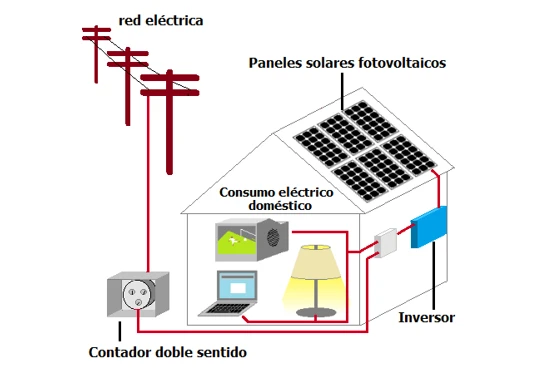
- Lower Electric Bills: A Direct Impact: When you generate your own electricity with solar panels, you drastically reduce, or even eliminate, the power you buy from the grid. That translates into significant savings on your monthly or bimonthly electric bill.
- Return on Investment (ROI): Calculating the Payback: Return on investment (ROI) measures how profitable an investment is. For solar panels, the payback period is calculated by dividing the total investment by the annual savings the system generates. For example: if you invest $100,000 MXN in a solar panel system and save $20,000 MXN a year on your electric bill, your payback period is 5 years ($100,000 / $20,000 = 5). For a more accurate figure, factor in your energy consumption, your location (how much sun the area gets), and the cost of electricity where you live.
- Incentives and Subsidies in Mexico: In Mexico, there are government programs that offer incentives and subsidies for installing solar PV systems. Examples include programs from the Comisión Federal de Electricidad (CFE, the federal electric utility) and state-level programs. Looking into what's available in your area can help lower your upfront cost.
- Higher Property Value: An Investment That Appreciates: Installing solar panels can increase your property's value. Buyers increasingly value homes with renewable energy systems, because they mean long-term savings and a commitment to the environment.
The Environmental Benefits of Solar Energy: A Commitment to the Planet
- Cutting CO2 Emissions: Fighting Climate Change: Generating electricity from fossil fuels releases large amounts of carbon dioxide (CO2), one of the main greenhouse gases responsible for global warming. Because solar energy doesn't burn any fuel, it produces none of these emissions.
- Less Dependence on Fossil Fuels: Toward a More Diverse Energy Mix: Dependence on fossil fuels (oil, coal, natural gas) creates energy security problems and contributes to environmental pollution. Solar energy offers a clean, renewable alternative that reduces that dependence.
- Conserving Natural Resources: Using Energy Responsibly: Unlike conventional power plants, solar power generation doesn't consume large amounts of water or other natural resources.
- Building Sustainability: A Sustainable Energy Future: Solar energy plays a key role in the transition to a more sustainable energy model built on renewable, environmentally friendly sources.

Invest in Your Future and the Planet's
Installing solar panels is a smart investment that delivers real financial benefits and helps protect the environment. Contact us for a custom quote and start saving today!